
What is a Reggio Emilia daycare? A guide for Zurich parents
How a Reggio Emilia daycare works, what 'the hundred languages of children' means, what happens in the atelier, and what to look for when visiting one in Zurich.
What is a Reggio Emilia daycare?
A Reggio Emilia daycare follows an approach that grew out of the northern Italian city of Reggio Emilia after 1945. Its founding educator, Loris Malaguzzi, shaped the central image: "the hundred languages of children." Children think and express themselves in many ways at once — speaking, drawing, building, dancing, telling, photographing — and a Reggio-inspired kita gives all of those languages materials, space and attention. Compared with a Montessori daycare, the day is project-led and collaborative rather than material-led and individual: children pursue a shared question over weeks, and that question often emerges from something the children themselves noticed.
On cost, the usual rules apply. In Zurich, Reggio-inspired daycares follow the city tariff model — typically CHF 130.– to CHF 160.– per day without subsidy, scaling with household income for subsidised places, with a floor around CHF 7.50 per day at the lowest-income end. One honest note for parents searching: in Switzerland, pure Reggio houses are rare. Most kitas with a Reggio reference describe themselves as "Reggio-inspired" and combine the approach with other elements. That's not a misleading label — it reflects the Swiss pragmatic style — but it's worth asking each house, in plain language, what Reggio actually means for them in practice.
What Reggio actually is
Reggio Emilia is a provincial city of about 170,000 people in the Emilia-Romagna region of northern Italy. After the Second World War, parents there founded the first municipal kindergartens together with Loris Malaguzzi, explicitly as a response to fascism. The idea was simple and political: take children seriously, give them voice and a hand in shaping their environment, and you raise citizens rather than order-takers. Everything else in Reggio grows from that root, and it explains why Reggio isn't only a teaching method but a stance — a view of the child as competent, curious and social.
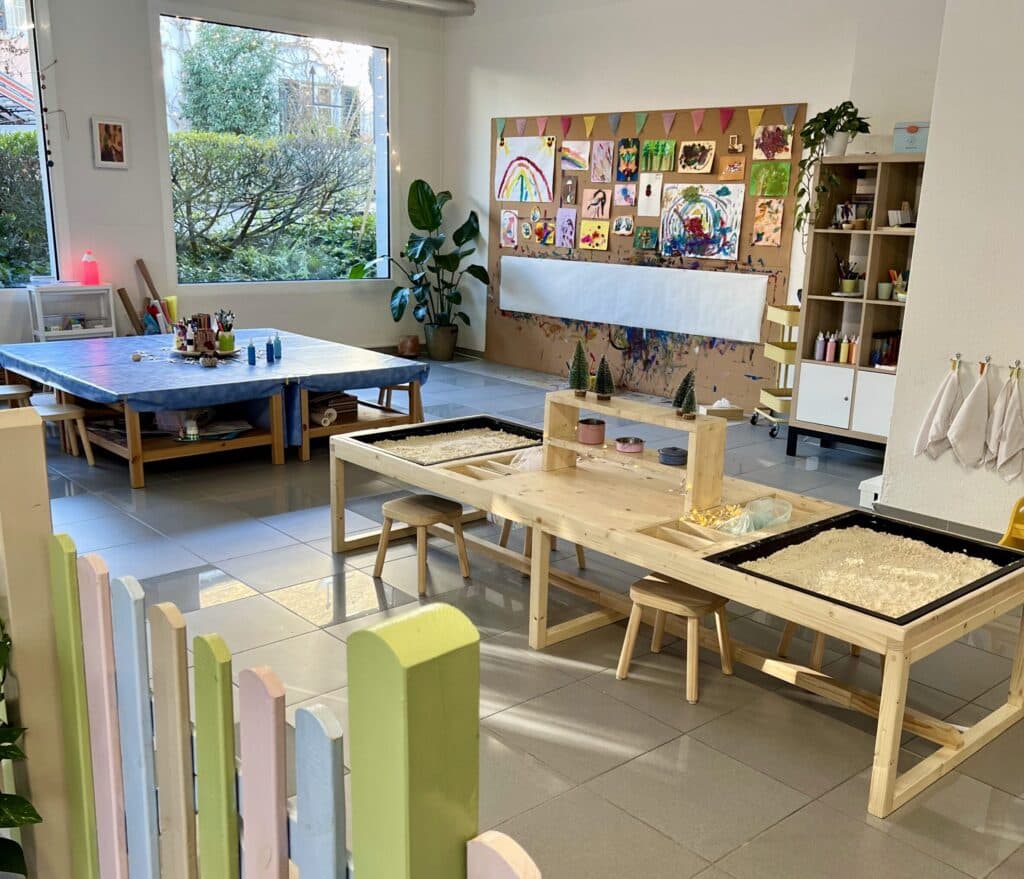
Three concepts carry the rest of the system. First, the image of the child: a competent, active researcher, not an empty vessel waiting to be filled. Second, the hundred languages: speaking, drawing, building, dancing, photographing, modelling — all equal ways to show a thought. Third, the educator as researcher: the staff member doesn't lecture but observes, documents and asks questions that carry a child's thinking forward. From these three flow the rooms you see in a Reggio kita: the atelier as a creative workshop, the piazza as a meeting space, the documentation walls where ongoing projects hang for everyone to read.
A day in a Reggio-inspired daycare
The day feels more open than at a Montessori or Waldorf house, but it isn't unstructured — the structure just isn't material or weekly rhythm; it's a running project. After arrival and a brief group circle in which the children recap where they left off yesterday, they move into project work. Three children might continue building the shadow model they've been investigating for two weeks. Two others draw, in ink, the beetle they noticed on the way in this morning. An atelierista sits in the studio with one child experimenting with a light box and translucent shapes, because "light and shadow" is the topic threading through the room this month.
After that comes a shared lunch — in the Reggio tradition this is its own ritual, with table-setting, conversation and clearing up, not a functional refuelling stop — and a long outdoor block. The afternoon often involves documentation: sketches collected, photos printed, the wall updated for parents arriving at pickup. That documentation isn't display; it's part of the learning. By making visible what children are thinking, educators learn where to pick up tomorrow.
Strengths and weaknesses, honestly
The strengths are pronounced. Reggio develops verbal clarity, social negotiation and creative expression as well as any pedagogy in early childhood. Children learn early to articulate their thinking, explain what they made, and respond to the thinking of others. The age-appropriate complexity of long-running projects gives them the experience that one question can carry across weeks — a useful counterweight to a culture of short, attention-grabbing stimuli.
The trade-offs are real. Reggio offers less individual, solitary concentration time than Montessori — if you have a child who flourishes most in self-chosen, focused material work, weigh that. Compared with Waldorf, Reggio lacks the weekly rhythm that gives some children security: in Reggio, every morning is a little different because the project moves. And quality depends heavily on staffing. A real atelierista with both an arts background and pedagogical training is rare and expensive; some "Reggio-inspired" houses don't have one on the team and you'll see it in how the atelier is used.
What this means for an expat family
A few practical points for international parents. Language: most Reggio-inspired daycares in Zurich run in German with some English exposure; a small number are fully bilingual German-English. Ask in your first email which language is used during projects, meals and outdoor time — that's what shapes your child's exposure. Application timing: spots in well-known Reggio-inspired houses tend to be limited because the network is small. If your B-permit just came through, register at two or three houses in parallel and assume one will move first. Administrative support: Reggio houses tend to be smaller independents, often run by a director with a pedagogical rather than commercial background. Replies are usually warm but not always quick. International schools: a Reggio-inspired upbringing transitions into both Swiss state schools and English-language internationals; the project-and-discussion style is unusually well-aligned with International Baccalaureate primary years, if that's on your medium-term path.
Who Reggio suits
Reggio works for children who flourish in a group, who talk a lot and build stories, and who love joint investigation. It works for families ready to take a child seriously as a conversation partner — willing to listen at home when the child explains what she made, and to read the kita's documentation walls as an invitation rather than as wallpaper. If your child wants long stretches of independent depth and gets overstimulated in a busy group, look at Montessori in parallel. If your child needs strong rhythm, repetition and quiet imaginative space, Waldorf is the better fit.
Where to find a Reggio-inspired daycare in Zurich
The houses below are the daycares within the city of Zurich that we record as clearly Reggio-aligned. The supply is small — work through this list and you've effectively seen the city's Reggio field.



The full hub of every Reggio-aligned daycare we track sits at /en/zurich/pedagogy/reggio_emilia. If you want to put Reggio next to the other classic respect-the-child line, the Montessori explainer is the natural companion, and Montessori vs Waldorf covers the other classic comparison.
Frequently asked questions
What is a Reggio Emilia daycare?
A daycare that follows the approach developed in the northern Italian city of Reggio Emilia after 1945. The educator Loris Malaguzzi shaped its central idea — 'the hundred languages of children': children think and express themselves in many ways at once, and a good kita gives all of those ways materials, time and attention.
What's the difference between Reggio and Montessori?
Reggio is project- and group-led; Montessori is material- and individual-led. Reggio children investigate one topic collaboratively over weeks; Montessori children choose from self-correcting materials. Reggio makes learning visible on documentation walls; Montessori prefers quiet observation in the guide's notebook.
What's the atelier in a Reggio daycare?
A dedicated creative studio stocked with art, building and natural materials, often staffed by an atelierista — a resident artist-educator. The atelier isn't the craft corner: it's the pedagogical centre, the room where what the children are currently thinking gets condensed into making.
Are Reggio daycares more expensive in Zurich?
Usually no. Tariffs follow the city model — typically CHF 130.– to CHF 160.– per day without subsidy. Pedagogy-based surcharges are uncommon, and houses that take subsidised places use kibon like everyone else; the floor for the lowest household incomes is around CHF 7.50 per day.
Are there real Reggio daycares in Zurich?
Pure Reggio houses are rare in Switzerland. Most Zurich daycares with Reggio leanings call themselves 'Reggio-inspired' and combine the approach with elements from other pedagogies. That's not a marketing trick — it's the Swiss pragmatic style — but worth knowing if you're hoping for the strict Italian form.
What does 'the hundred languages of children' mean?
A metaphor from Loris Malaguzzi: children think and express themselves in a hundred ways, not just verbally. A Reggio daycare takes that seriously and gives those ways — drawing, building, telling, dancing, photographing, modelling — equal status. It's a critique of pedagogies that only value spoken language.
What does documentation look like in a Reggio kita?
Educators record what children think about a topic in notes, photos and sketches, then build documentation walls — visible in rooms and the entrance — that show the current project to children, parents and team. The documentation is part of the learning, not a school report at the end.
Next step
The full list of every Reggio-aligned daycare in the city, filtered by Kreis, age band and subsidy status, is at /en/zurich/pedagogy/reggio_emilia. To weigh Reggio against the other classic respect-the-child line, start with the Montessori explainer and the head-to-head in Montessori vs Waldorf. For application logistics and money-side practicalities, the Zurich registration guide and the cost guide sit alongside this post.
Keep reading
Bilingual daycare in Zurich — pros, cons, and the right age to start
Whether bilingual daycare is worth it, when to start, what OPOL really means, and which language pairs Zurich actually offers — for expat families weighing options.
What is a Waldkita? Forest daycare in Zurich, explained
How a Waldkita (forest daycare) works, what a typical day looks like in summer and winter, what children learn, and what expat parents in Zurich should know before applying.
What is a Montessori daycare? A guide for Zurich parents
How a Montessori daycare in Zurich works, what a typical day looks like, what it costs, and which children it suits — written for parents weighing pedagogies.