
Top Montessori Daycares in Zurich Kreis 6 (Unterstrass / Oberstrass)
Montessori daycares in Unterstrass and Oberstrass — Zurich's densest Montessori cluster, with notes on age bands, daily costs, and waitlists for expat families.
Kreis 6 — Unterstrass and Oberstrass — has the densest Montessori daycare cluster in the city of Zurich. The neighbourhoods sit on the slope rising from Hauptbahnhof toward the ETH and Universitätsspital, with one of the highest children-per-hectare ratios in the city, and the daycare supply has grown to match. Three Montessori-aligned houses have stood out across visits and parent feedback. Without subsidy, daily rates run CHF 130.– to CHF 160.– — the standard Zurich band, since pedagogy premiums are unusual here. With Stadt Zürich subsidy, the rate scales with household income: the floor is around CHF 7.50 per day, the cap around CHF 130.–. Whether you qualify is calculated by kibon, the city's registration platform; English support is built in. If you're moving from abroad on a B-permit, apply 9–12 months ahead — the established programmes have multi-month waitlists.
The picks

Kita Allegra by pop e poppa Beckenhof
Kita Allegra by pop e poppa Beckenhof on Beckenhofstrasse runs under the pop-e-poppa banner — a Romandie-rooted operator with an established multilingual line. The Kreis 6 site layers a DE-EN bilingual model with Montessori-oriented daily structure: prepared environment, mixed-age groups, long uninterrupted activity cycles. The Beckenhof location is tram-friendly (lines 7, 14) and walking distance from ETH and Universitätsspital, which matters for hospital and university affiliated families who sometimes have priority access via kihz arrangements. Expect a multi-month waitlist on the standard route.
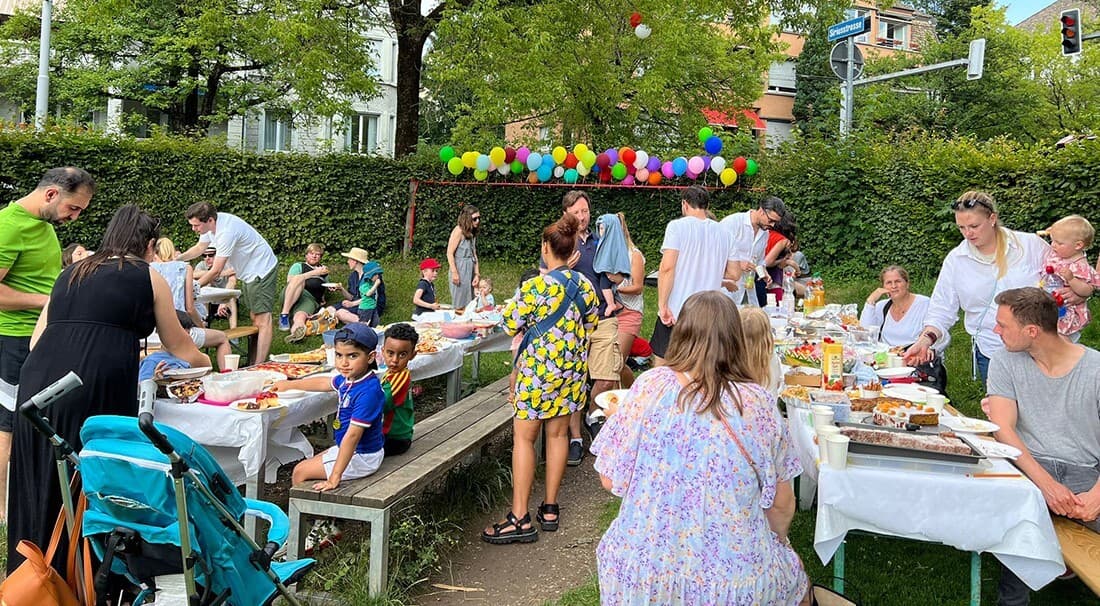
Montessori Kindergarten Blumenwiese
Montessori Kindergarten Blumenwiese in Oberstrass covers the Kindergarten-age (3–6) band and is the natural next step for children who finished the Krippe phase at Allegra or comparable houses. The transition into the Swiss public Kindergarten system at age 4 is a real consideration for expat families — public Kindergarten runs in Swiss-German — and Blumenwiese threads that needle by keeping German as the day language while running Montessori method. Waitlists for the 3–6 band tend to be shorter than for 0–3, simply because demand pressure is heavier in the Krippe phase.
How they compare
| Field | Kita Allegra by pop e poppa Beckenhof | Montessori Kindergarten Blumenwiese |
|---|---|---|
| CHF/day | – | – |
| Min age (months) | 3 | 36 |
| Max age (months) | 144 | 84 |
| Outdoor space | – | ✓ |
The meaningful difference is age band — Allegra covers the Krippe years, Blumenwiese the Kindergarten band — and outdoor access. Daily rates cluster within the standard Zurich range. For families wanting continuity from infant through pre-school, the natural pairing is Allegra (0–3) followed by Blumenwiese (3–6).
Where they sit on the map
The two houses sit within a 10-minute walk of each other in the Beckenhof / Oberstrass corridor. Trams 7, 9, 10, and 14 cover Kreis 6 densely; S-Bahn Stadelhofen is 10 minutes on foot. Universitätsspital sits at the western edge of the catchment, ETH at the eastern. Driving in is workable but parking is regulated.
Practical wrap-up
- Waitlist: Plan for 6–12 months at the established Montessori programmes. Apply 9–12 months ahead.
- Hospital / university priority: Universitätsspital and ETH affiliated families sometimes have priority via kihz. Worth checking with HR or the kihz Familienservice.
- Subsidies: Stadt Zürich subsidies apply at participating houses; check each on kibon.
- Long-arc fit: For a continuous Montessori arc from infant to pre-school, pair Allegra (0–3) with Blumenwiese (3–6).
For pedagogy background, see Montessori explained and Montessori vs Waldorf. The Kita comparison Kreis 6 post shows how Montessori positions against other pedagogies in the same neighbourhood. For broader Zurich application logic, finding a daycare spot in Zurich walks through kibon and the paperwork sequence.
Frequently asked questions
Which Montessori daycares are best in Zurich Kreis 6?
Kreis 6 — Unterstrass and Oberstrass — has Zurich's densest Montessori cluster. The post below covers the strongest picks; the Kreis 6 hub page lists the full set across all pedagogies.
What does daycare cost in Zurich Kreis 6 per day?
Without subsidy, full-time care in Kreis 6 runs CHF 130.– to CHF 160.– per day. With Stadt Zürich subsidy, the rate scales with household income — the floor is around CHF 7.50 per day, the cap around CHF 130.–.
Are Montessori daycares more expensive than standard daycare in Zurich?
No, generally not. Pedagogy premiums are unusual in Zurich; rates follow the city model and many Montessori houses accept city subsidies on the same terms as standard kitas.
How dense is the Montessori scene in Kreis 6?
Densest in the city. Unterstrass and Oberstrass have a high children-per-hectare ratio, and the daycare supply has grown in step. Multiple Montessori-aligned houses sit within 10 minutes of each other.
What ages do Kreis 6 Montessori daycares cover?
Most cover both the Krippe (0–3) and Kindergarten (3–6) phases; some run mixed 0–6 groups, which is closest to the Montessori ideal. The comparison below shows each house's range.
How long is the waitlist for Montessori in Kreis 6?
At established programmes, expect 6–12 months. Apply 9–12 months ahead. Hospital- or ETH-affiliated families sometimes have priority via kihz arrangements.
Keep reading
Top 3 Bilingual Daycares in Zurich Kreis 1 (Old Town)
Three bilingual daycares in Zurich's Old Town — DE-EN immersion, central locations near ETH and Paradeplatz, with notes on waitlists, B-permit timing, and subsidies.
Top 3 Bilingual Daycares in Zurich Kreis 4 (Aussersihl / Langstrasse)
Three bilingual daycares in Aussersihl, Werd, and Langstrasse — DE-EN immersion, multicultural Quartier, with notes on subsidies, waitlists, and B-permit timing.
Top 3 Bilingual Daycares in Zurich Kreis 5 (Industriequartier)
Three bilingual daycares in Zurich's Industriequartier and Escher Wyss — DE-EN immersion near tech employers, with notes on extended hours, employer quotas, and waitlists.